Abstract
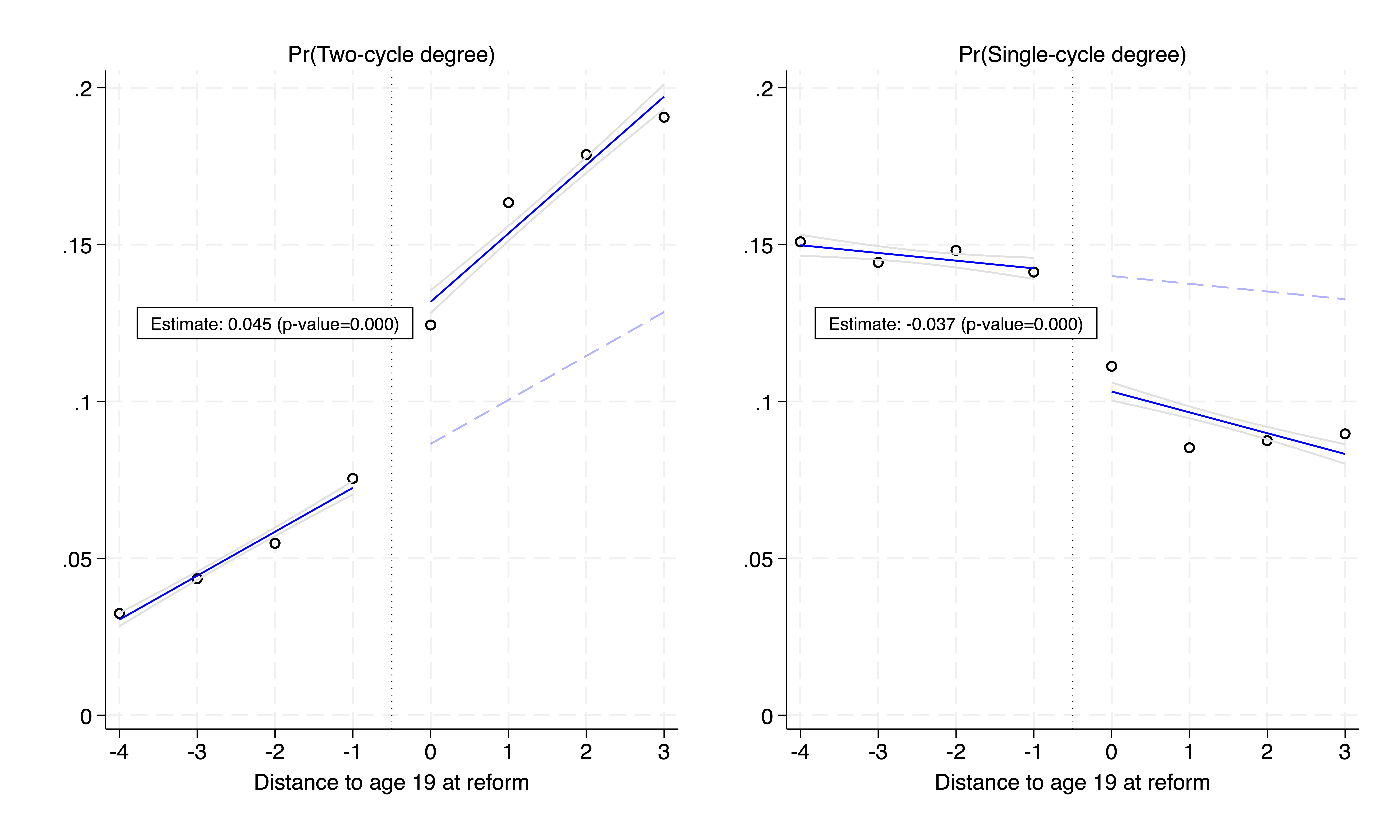
This paper studies how students react when they are exposed to a more flexible university system, with the option of getting a less specialized university degree in shorter time. Using a Regression Discontinuity design that exploits the roll-out of the Bologna Reform in Italy, I compare education and labor market outcomes for cohorts of individuals who were deciding to go to university right before and right after the reform was implemented. Ex-ante, the impact of the reform on university attainment is ambiguous: schooling might increase because more people go to university, but it might also decrease if students who previously would have completed a longer degree now opt to finish studying after a shorter 3-year degree. I show that both mechanisms are at play but that females, on net, spend 0.15 more years in university. This increases female earnings by 1.5-2% while keeping their employment probability constant, implying a return to one year of university of at least 10%. The results are mostly driven by more women graduating from healthcare degrees - a 30% increase - which has important implications on their occupation. They are more likely to work in the healthcare sector, for which a short 3-year degree provides sufficient preparation, and less likely to work in administrative roles. These findings highlight the importance of tailoring educational reforms to the specific demands of different career paths.
Figures